
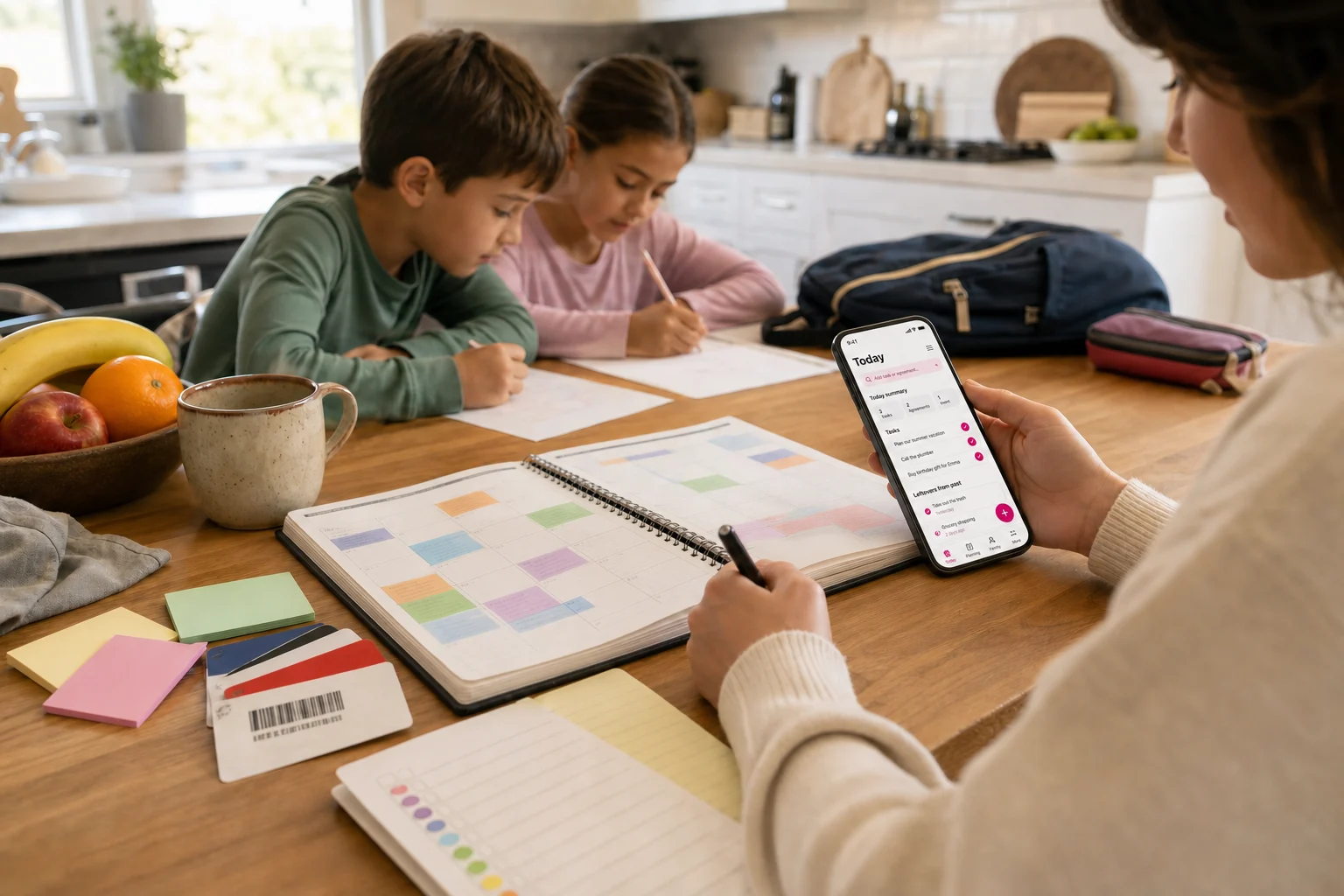
What we actually use Asynq Family for
Family life is not one thing.
It is a stream of tiny decisions, recurring responsibilities, school logistics, errands, appointments, plans, reminders, and handoffs.
That is why Asynq Family is not designed as a traditional calendar.
It is closer to a family operations board.
In our own home, we use it for the practical things that usually get scattered across memory, messages, paper notes, screenshots, and half-finished conversations.
Personal tasks that still affect the household
Some things start as purely personal tasks.
I need to call someone.
I need to plan a vacation.
I need to remember something before a meeting.
These are not always “family events,” but they still affect the rhythm of the day. If I am late because I forgot a call, or if vacation planning stays in my head for too long, the household feels it.
So I capture these tasks in Asynq Family instead of leaving them in a private mental queue.
The goal is not to turn every thought into administration.
The goal is to stop important practical things from depending on someone remembering them at exactly the right moment.
Household agreements
The second category is the one that matters most emotionally: agreements.
Who takes out the trash, and when?
Who cleans what?
Who is responsible for a recurring chore this week?
These are small tasks, but they can create a disproportionate amount of friction when they are informal. If the agreement only exists in a conversation from Sunday evening, someone has to carry it, repeat it, and defend it later.
In Asynq Family, the agreement becomes explicit.
It has a person.
It has a time.
It has a shared place.
That changes the tone. The task is no longer floating between people. It belongs somewhere.
Events, appointments, and work commitments
We also use it for events that look more like a normal calendar item:
- dentist appointments
- work meetings
- family visits
- one-off commitments
The difference is that these events do not live separately from the rest of the family plan.
If I have a work meeting, that may affect pickup.
If one of us has a dentist appointment, someone may need to adjust dinner, childcare, or transport.
The point is not just to record that something exists.
The point is to see what it changes.
Plans for children, school, activities, and travel
The biggest daily value comes from planning around our children.
We track when each son is at school or kindergarten, when they have activities, and what needs to happen around those blocks of time.
The plan itself is only half of the story.
The important part is the related agreement:
- who takes him there
- who picks him up
- whether anything needs to be packed
- whether the plan changes because one parent is unavailable
Children can be added even when they are too young to connect to the app themselves. They still get their own color in the planner, and the family can plan around them clearly. Later, when they are old enough, they can join more directly.
We use the same model for bigger plans too:
- vacations
- trips
- family visits
- weekends away
The planner can show the day, the week, or the month, so it works both for immediate handoffs and for seeing the shape of a busier period.
Shopping lists and shared errands
Shopping is a simple but useful example.
If I know my wife is going shopping, I can add items to her shopping list instead of sending another message that may get lost.
That is a small thing, but these small things compound.
The list is where the action is.
The message is no longer the system.
Loyalty cards without more shopping apps
My wife also added the different barcodes and QR codes from our loyalty cards.
That means I do not need to install every separate shopping app just to scan a card at checkout.
It is another example of the same principle: the family does not need more scattered tools. It needs the practical things in one reliable place.
Two views: today and the family planner
In everyday use, Asynq Family has two main views.
The first is the Today overview.
That is where I see what concerns me now: my tasks, my agreements, my events, and the things that need attention today.
I can also go back to any previous day or look ahead into the future. And most importantly, today's overview shows what I did not manage to finish before, so unfinished things do not silently disappear.
The second is the Planner.
That is the family planning calendar. Every family member has a color, including children, so the whole week becomes easier to scan. It is not just a list of events. It is a map of who is where, what needs to happen, and who owns the handoff.
Capture should be fast
A family system only works if adding things is easy.
That is why agreements can be entered in several ways:
- manually
- as plain text, such as “every Monday at 4pm I take my son to his activity”
- by voice
- by taking a photo of an invitation, flyer, or document with event details
The form should not be the hard part.
The hard part is already the family logistics.
What the app is really for
When people ask what Asynq Family does, the short answer is easy:
it helps families plan, remember, and agree.
But the more honest answer is this:
it reduces the amount of family life that has to live in someone’s head.
That is the part that matters.
Because when tasks, plans, lists, events, and agreements have a shared place, the home becomes easier to coordinate.
Not perfect.
Just clearer.